Understand what changed
Aligned observations and a reversible WholeContext Digital Twin™ keep recorded history separate from assumptions.
 WholeContext AIAbout connected workspaces
BUILD TOWARD A 360° VIEW OF HEALTH
Permissioned email and records. Patient experience. Images and federal data. One longitudinal story for continuity of care.
Connect diaries, caregiver observations, images and U.S. federal data. Track function, treatment response and quality of life—with sources, uncertainty and patient control visible.
Explore all five portals ↓Welcome to WholeContext AI. I'm Kimberly Chulis, and I'm here to introduce a more connected care journey. Patients need their story to travel with them. Physicians need a clear history and continuing insight into response. Caregivers need to know how to help. These connected portals bring that relationship together around the patient's goals. Each workspace carries the relevant parts of the same story across the care continuum.
The Patient portal pulls fragmented records, diaries, emails, photos, symptoms, and treatments into one timeline. Patients can review, correct, and add details as their story develops, easing the work of remembering and reexplaining everything at each visit. Their goals stay visible as the story grows.
That story becomes a short previsit video. The workflow centers on patient review: correct or add context, regenerate, and approve the version to share. In about a minute, the briefing brings together the history, what's been tried, the response, and what matters most to this person. The same information carries into the previsit PDF.
The WholeContext Evidence Profile gives that PDF a clear clinical structure. Color-coded conditions for consideration sit alongside documented findings, questions for investigation, and original sources. The physician can move from this summary into the full intake, timeline, treatment history, and supporting evidence.
Records stay linked to their sources, making each finding inspectable at a glance. AI-assisted evidence mapping helps surface connections and options for clinicians to explore, preserving valuable face-to-face time for better-informed discussion. Clinical diagnosis and treatment decisions remain with the clinical team.
The WholeContext Digital Twin gives the patient's experience a visual, longitudinal representation. Tap the anatomical model to describe pain by location, severity, duration, and sensations such as burning, throbbing, or numbness. Rashes, swelling, and restricted movement add detail.
Rotate the body and replay dated observations to see how symptoms move and change. Patients gain a precise way to communicate their experience, and clinicians gain more specific clues to explore together.
Open data adds another layer of understanding. OpenDataDelta connects selected federal and public data with relevant time and location, bringing previously disconnected context into view.
Here, the same one hundred forty-two patient-source records are shown before and after adding thirty-nine public measures. Condition-specific surveillance, air and water quality, community health, and access to care broaden the picture. Compare evidence coverage across clinical topics, then open a gauge to inspect its sources. Alongside the color-coded Evidence Profile, these comparisons help the team understand what supports each consideration and what to explore next.
The Discovery Lab puts this research directly at the physician's fingertips. Explore a location, compare communities, inspect source dates and geography, and follow observations back to their evidence. Clinicians and researchers can investigate patterns and bring relevant context back into the individual care conversation.
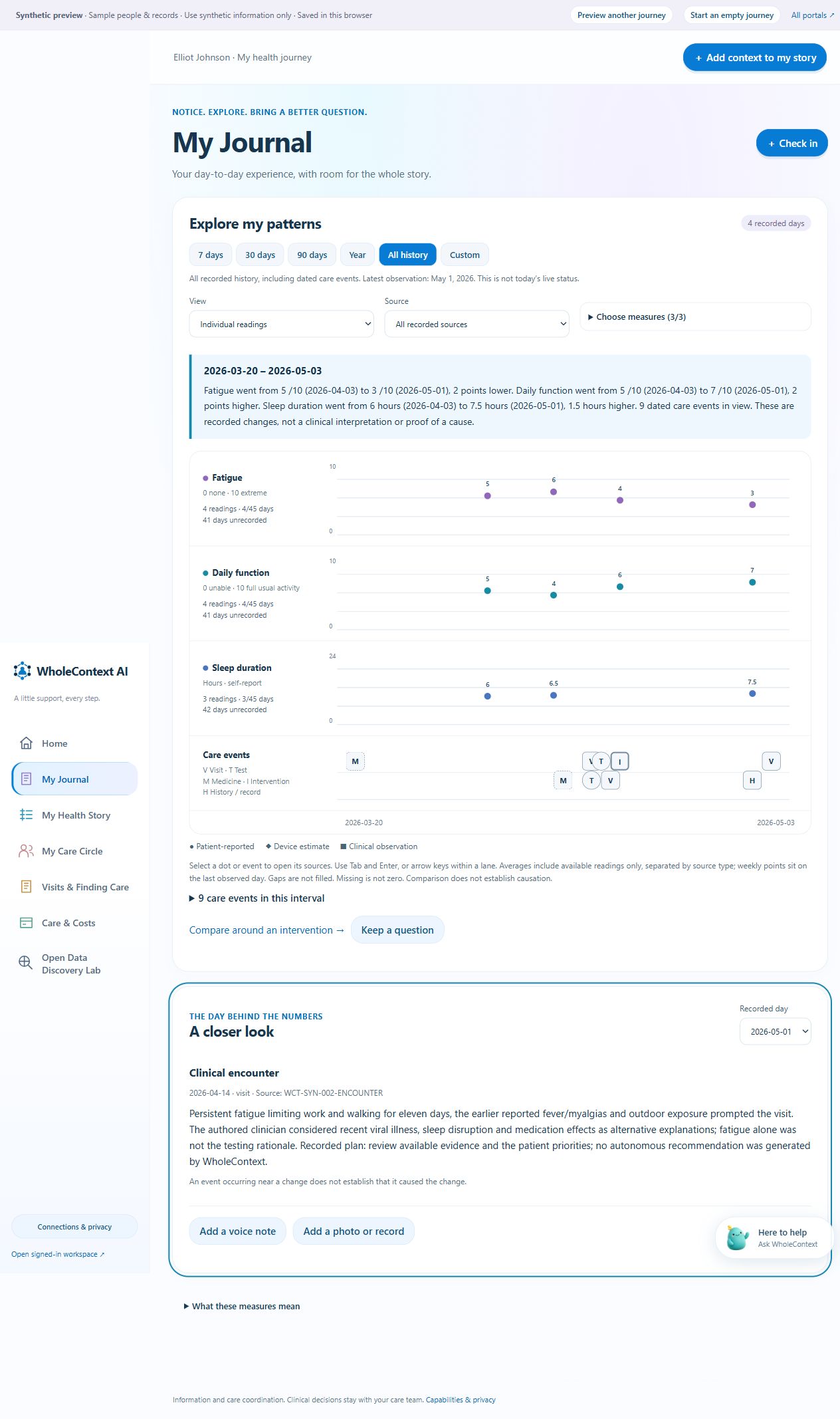
After the visit, the relationship continues. Health and Progress brings the question "What has changed?" into focus. Track pain, fatigue, sleep, movement, daily function, and treatment response over time, alongside diary entries, device estimates, and caregiver observations.
The team can see how an intervention relates to everyday well-being. Seven-day outlooks display estimated trajectories with observed readings and uncertainty. What Changes If lets the team explore assumptions and practical scenarios. New observations inform the next review, update the Twin, and enrich the next briefing, creating an agile, ongoing picture of health and quality of life.
Knowing what's needed becomes practical support. Patients can prepare requests for help scheduling appointments, finding care, arranging rides, or picking up prescriptions. Support Circle gives caregivers specific ways to help while respecting the patient's independence and sharing choices.
Care Momentum shows where things stand, who is responsible, and when to check back, connecting each next step to the patient's goals. Care and Costs brings coverage, expenses, patient time, and caregiver effort into that picture. Patient control, privacy, security, and role-appropriate access guide the design.
That everyday value supports product-led growth: patients gain continuity, clinicians gain organized evidence, and supporters know how to contribute. We can measure preparation time, follow-through, function, and continued use.
Explore all eighty-four synthetic journeys, spanning different conditions and communities. WholeContext brings technology and public data into a more informed, connected care relationship that evolves with each person. Thank you to HHS, our federal mentors, and this community.
Explore a fictional patient journey. This demonstration uses synthetic records. Do not enter real patient information. Clinical decisions remain with qualified care professionals.
A little support for your next step.
Explore and add to your story, review evidence and prepare questions.
Start with your storyHelp with shared tasks and care questions, with patient permission.
Be there for someoneConnect original sources, clinical timelines and outcomes to support informed review.
Review the care pictureUnderstand expenses, coverage questions and the everyday impact of illness.
Make sense of costsExplore federal and open data. OpenDataDelta shows what available public context adds, with sources and gaps.
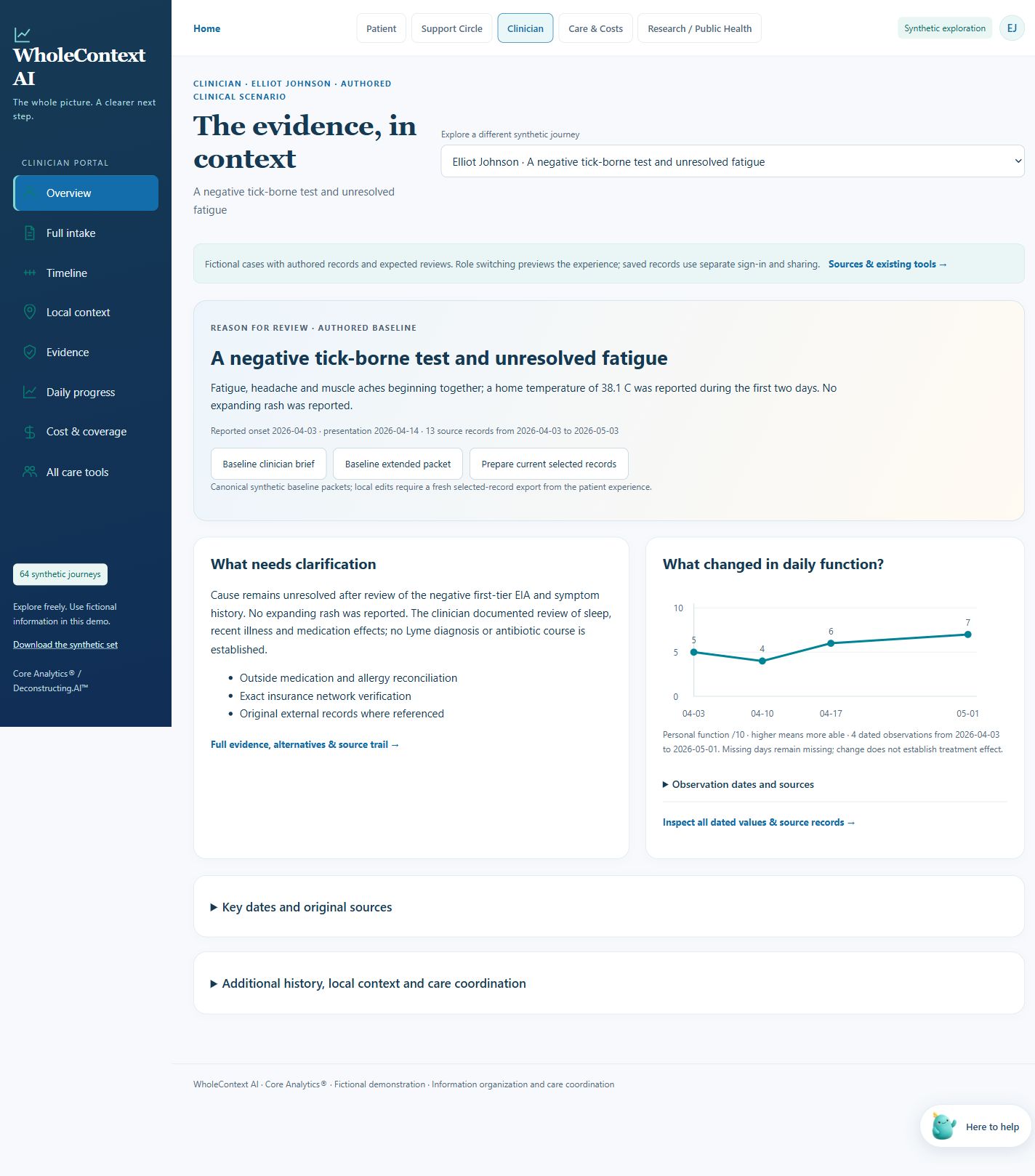
Discover your contextReview the selected patient’s story alongside dated clinical records and reported observations. Check what each source supports, what is uncertain and what belongs in the next care conversation.
Review the selected patient’s story →Review the selected patient’s sources →Choose a patient journey →Aligned observations and a reversible WholeContext Digital Twin™ keep recorded history separate from assumptions.
Track unanswered questions, handoffs, daily function and caregiver burden.
WholeContext Discovery Lab™ connects geographic and environmental data to their sources and limits.
Captured synthetic product views from earlier builds. Open a workspace to explore the current experience.
Authored synthetic examples with recovery, fluctuation and unresolved illness. No journey predicts another person’s outcome.
Fever and rash resolve while fatigue, pain and limitations in daily life persist.
Select this patient journey →Fluctuating shoulder and neck symptoms, daily function and overlapping clinical explanations.
Select this patient journey →Activity-related symptom worsening, a half-day work goal and a later clinician Long COVID assessment.
Select this patient journey →Rash improvement, persistent fever and later patient-specific evidence supporting babesiosis alongside Lyme.
Select this patient journey →Reported return to usual work and walking after early clinical Lyme treatment.
Select this patient journey →Persistent fatigue and pain, a corrected travel history and no established current Lyme disease.
Select this patient journey →Follow a more complete Lyme journey, informed by published Lyme Disease Biobank research: travel, early testing uncertainty, treatment, uneven recovery and a missed follow-up.
Explore Nora and six related stories → Browse all 84 patient stories →